Why We Built an AI Military Commander
I started my career at the FBI analyzing how adversaries think. Twenty years and two exits later, I'm still doing the same thing. Except now the adversaries are autonomous drones, and the analysts are AI models.
QLUU exists because of a math problem nobody wants to talk about.
A consumer drone costs a couple hundred dollars. A Patriot missile costs four million. That's a cost ratio that massively favors the attacker. You can field thousands of cheap drones for the price of a single interceptor. And that interceptor can only engage one target at a time.
We saw this play out in real operations. Large-scale drone and missile attacks were successfully intercepted, but at staggering cost. The attackers won the economics even when they lost the battle.
That's the problem. The solution isn't a better missile. The solution is a better brain.
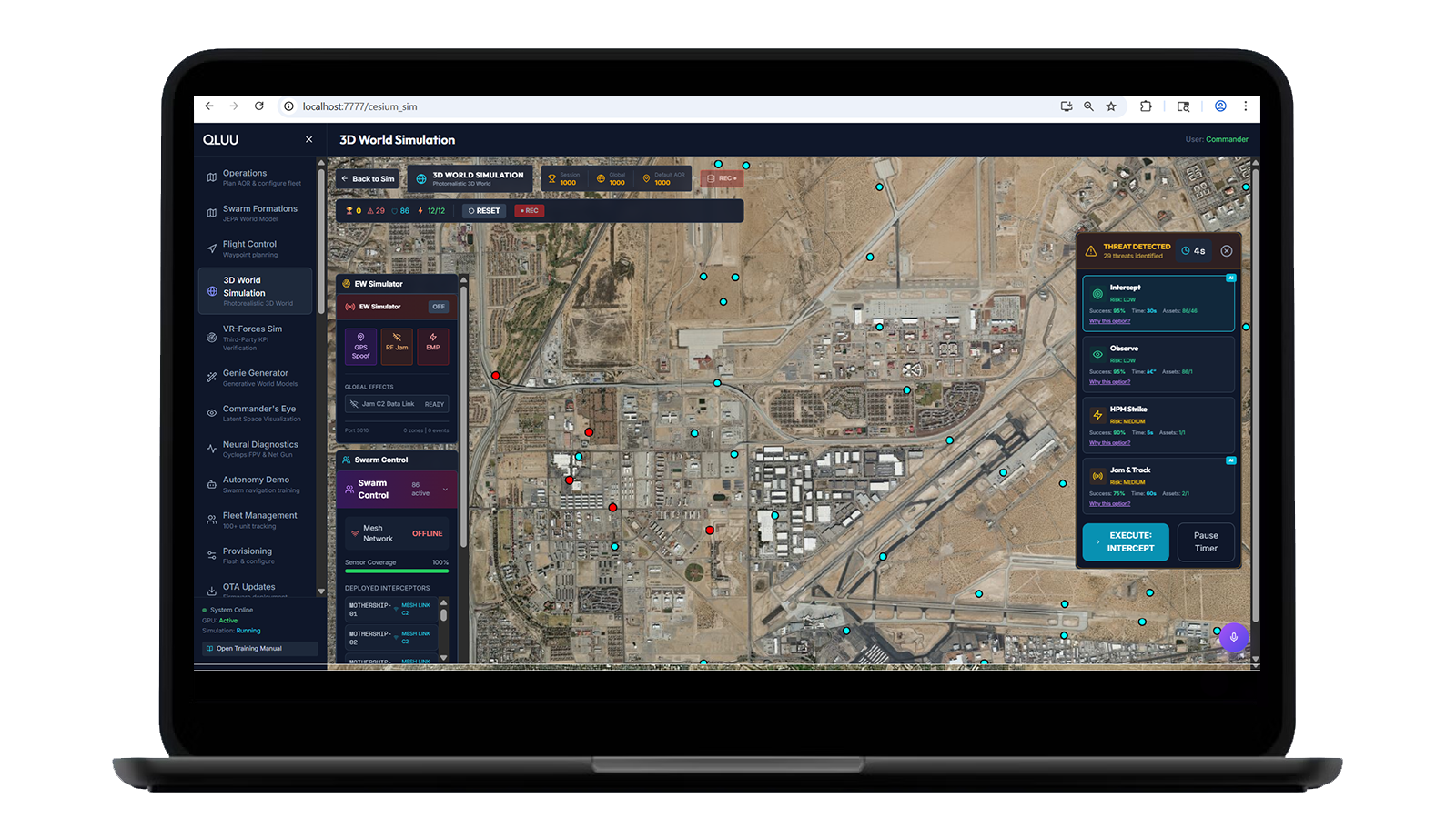
Commander Qluu is that brain. It's not a sensor. It's not a drone. It's an AI military commander that runs the full kill chain from detection to battle damage assessment faster than any human team can.
We built over 30 AI models from scratch. Not wrappers around commercial LLMs. Not fine-tunes of someone else's foundation model. Sovereign models trained on physics-accurate military simulation data, the same simulation platforms the DoW uses for doctrine development and wargaming.
At the core of the system is our trajectory prediction family. Eleven domain specialists that forecast where threats will be minutes into the future. Not just extrapolating a heading, which is what a Kalman filter from the 1960s does. Our models predict intent. They model the adversary's tactical decision-making and anticipate maneuvers before they happen.
We don't react to threats. We predict them. And that changes everything about how you defend a perimeter.