Sovereign AI for Defense: Why We Don't Call APIs
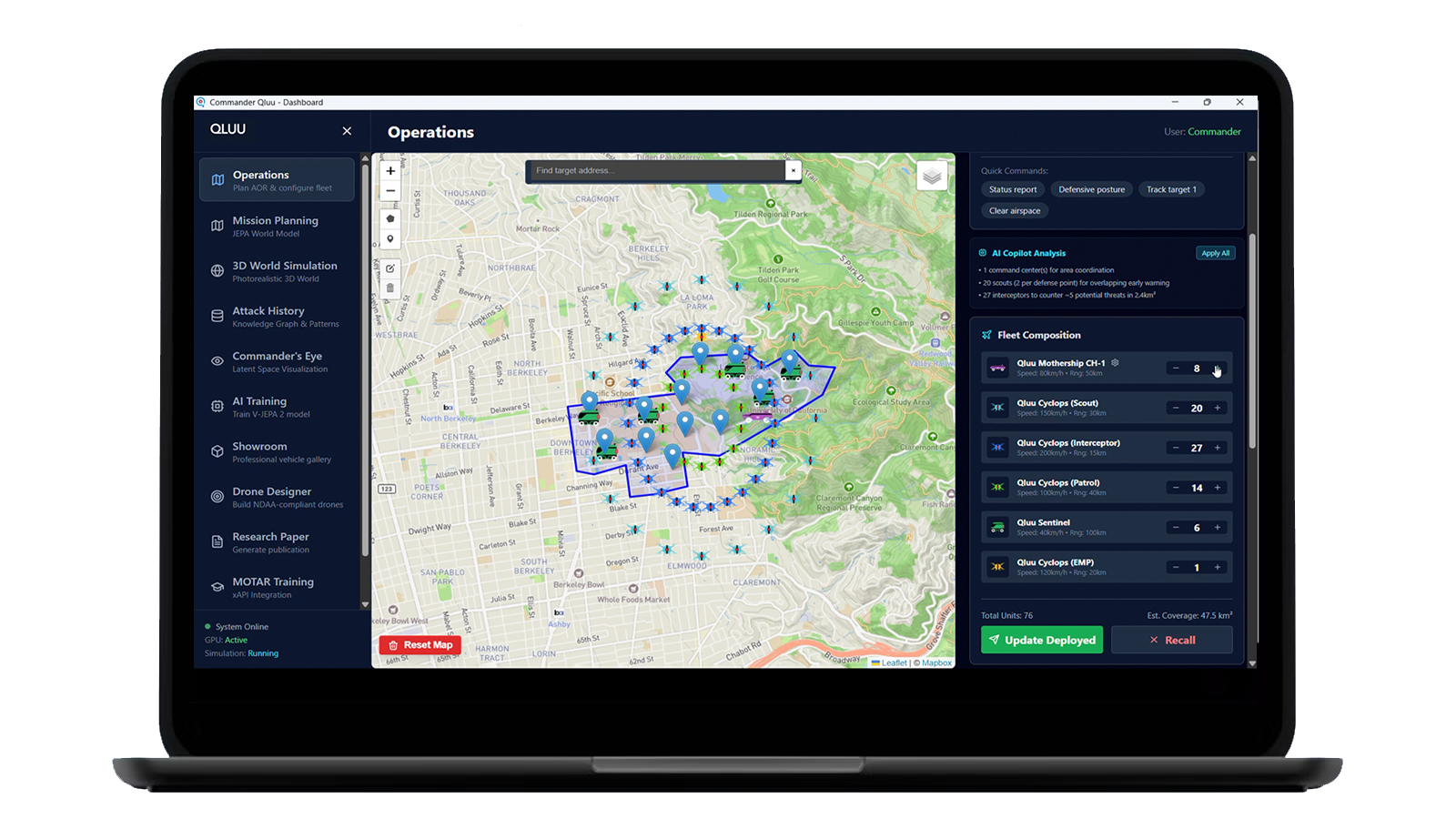
In Ukraine, Starlink outages left entire drone units blind for hours. In the Red Sea, Houthi forces jammed GPS and communications links across a 200-mile corridor. In the Pacific, military planners war-game scenarios where undersea cables are severed and satellite constellations are degraded on day one.
The pattern is clear: in every modern conflict, communications infrastructure is the first thing to go. And any AI system that depends on a cloud connection dies with it.
That makes edge sovereignty the single most critical component of any defense autonomy stack today. Not the model architecture. Not the sensor suite. The ability to keep thinking when the network goes dark.
We built QLUU around that constraint from the beginning. Every model runs on-device. Edge-native. Zero cloud dependency. No API calls. No internet required.
It wasn't just a technical decision. It became the design constraint that shaped everything we build.
What "sovereign" actually means
Most companies that say "edge AI" mean they run inference locally but train in the cloud using someone else's foundation model. Their model weights belong to Meta, or OpenAI, or Anthropic. They've fine-tuned someone else's brain. If that company changes their licensing, their terms of service, or their priorities, your defense system is at risk.
Our models are trained from scratch on our own simulation data. We own the weights. We own the training pipeline. We own the evaluation framework. We own the data. There is no third-party dependency chain between our AI and the mission.
Why this matters for ITAR and classified environments
In classified environments, no data can leave the network boundary. Period. A system that calls any external API, even a "private" cloud endpoint, requires accreditation paperwork that can take over a year and often fails. A system that runs entirely on local hardware with no network requirement? That's a different conversation entirely.
Our system deploys as firmware on tactical edge hardware. One device, one model, no outbound connections. The accreditation path is dramatically simpler because there's nothing to accredit. No data flows to audit, no API endpoints to monitor, no cloud provider to vet.
The sovereignty flywheel
Here's what most people miss: sovereignty isn't just about security. It's about speed.
When you own your entire stack, from training data to model architecture to deployment pipeline, you can iterate in hours instead of months. You don't wait for your cloud provider to support a new feature. You don't submit tickets to get access to fine-tuning APIs. You don't negotiate data processing agreements.
We run our entire AI development cycle on our own infrastructure. We generate simulation data, train models, evaluate them against held-out scenarios, and deploy to edge hardware. All internally, all without touching an external API.
Sovereign AI isn't a limitation. It's a competitive advantage. The companies that own their stack move faster, deploy cleaner, and don't wake up one morning to find out their AI provider just changed the pricing or the politics.